CNC engraving works particularly well for memorial designs that require precision, consistency and carefully controlled detail. It can be used to create lettering, borders, floral patterns, religious symbols, decorative ornament and personalised images on suitable memorial stone.
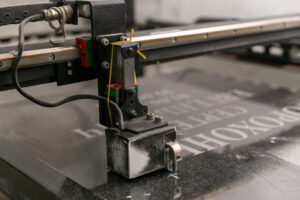
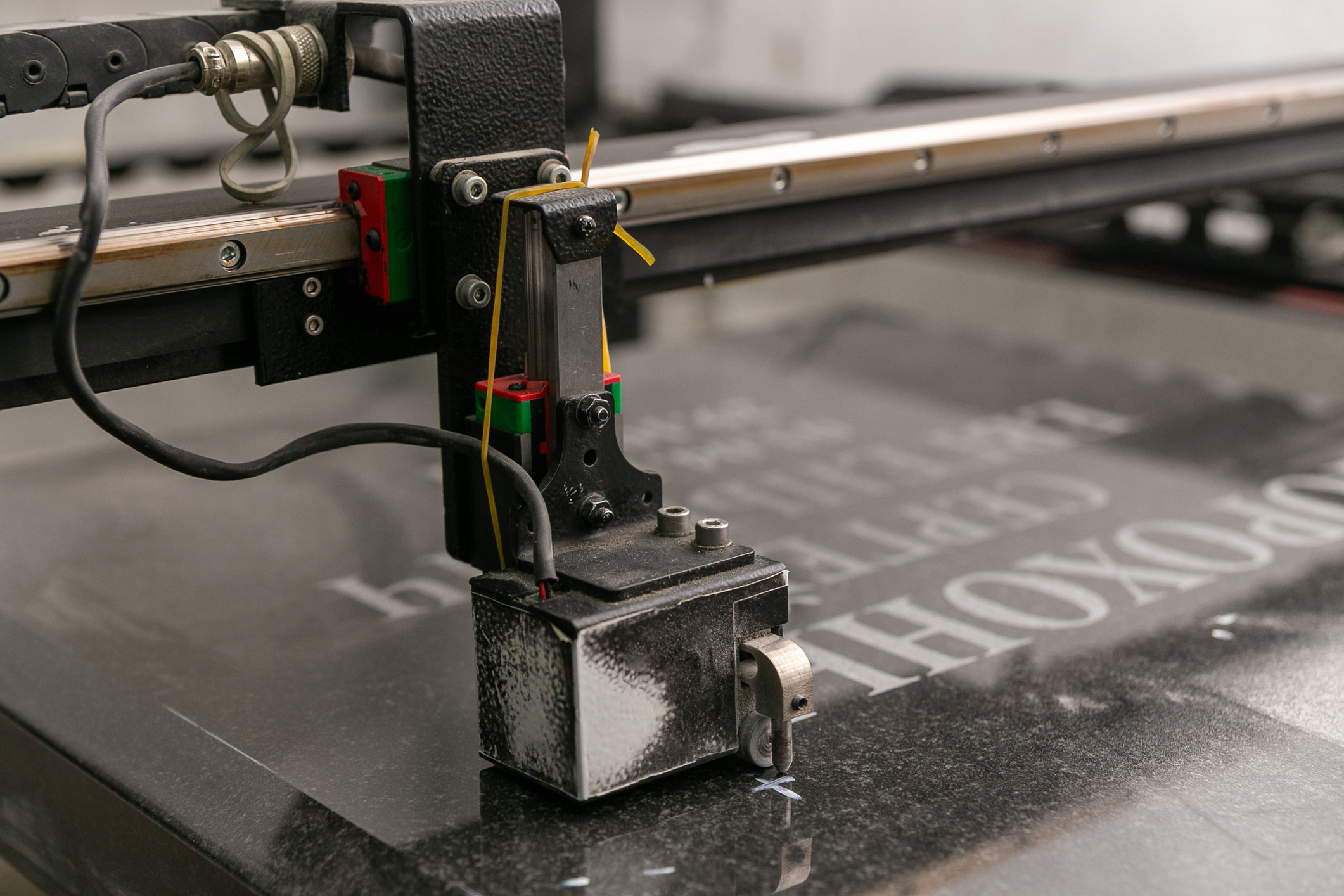
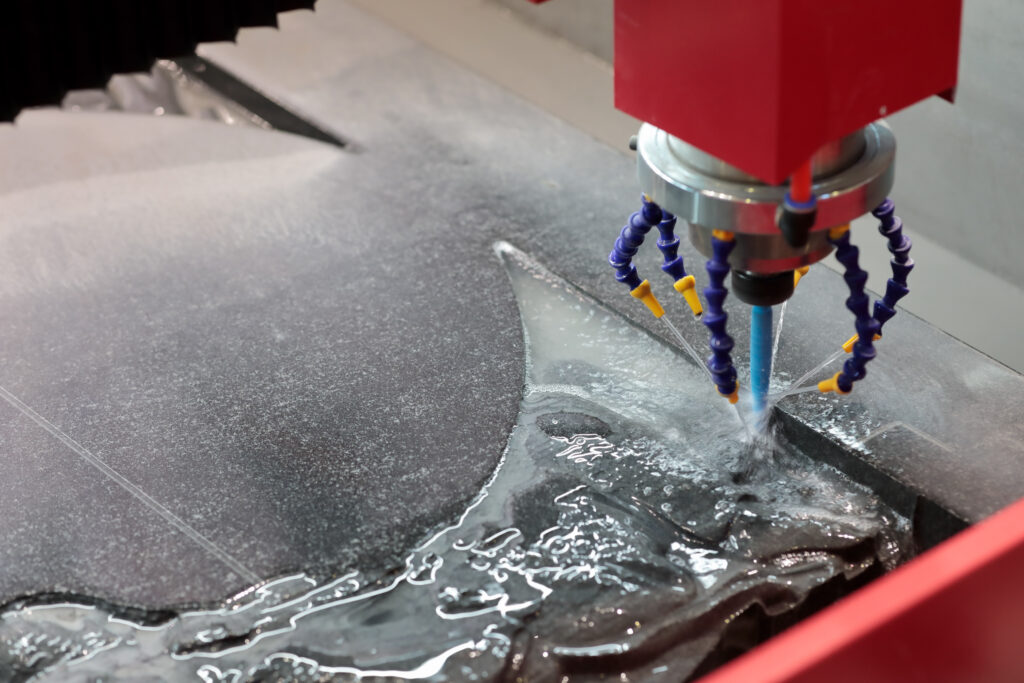
CNC stands for computer numerical control. In memorial masonry, this means a computer-guided machine follows a prepared digital design and cuts it into the stone using specialist tools. The process allows complex shapes and repeated details to be produced with a high degree of accuracy.
This does not mean every image is automatically suitable for CNC engraving. The design still needs to be adapted to the stone, the available surface area and the depth required for long-term visibility. Very fine lines may not reproduce effectively on a coarse-grained material, while crowded artwork can become difficult to understand once reduced to memorial size.
The strongest results usually come from designs that balance detail with clarity. Bold outlines, well-spaced lettering and carefully simplified images tend to remain more legible than overly complicated artwork.
Families should also remember that CNC engraving is one of several available methods. Hand carving, sandblasting, laser etching and ceramic photo plaques each create different visual effects. The right method depends on the intended appearance and the material selected.
What is CNC engraving in memorial masonry?
CNC engraving uses a computer-controlled cutting machine to remove stone according to a digital design.
The process begins with artwork created or prepared using design software. The mason determines the size, shape, line positions and cutting depths before programming the machine.
The stone is then securely positioned, and the cutting tool follows the programmed path. Different tools may be used for lettering, outlines, recessed areas and decorative details.
CNC machinery can create:
- V-cut or recessed lettering
- Geometric borders
- Floral ornament
- Religious and cultural symbols
- Repeated decorative patterns
- Shaped panels
- Line-based images
- Lettering in several typefaces
The machine provides accuracy, but the quality of the finished memorial still depends on the skill of the designer and mason. Poorly prepared artwork will not become effective simply because advanced equipment is used.
The operator must understand how deep to cut, which details to simplify and how the chosen stone will respond to the tooling.
Why is CNC engraving useful for memorial design?
One of the main advantages of CNC engraving is consistency. The machine can follow precise measurements and reproduce repeated shapes accurately.
This is valuable for borders, matching motifs and evenly spaced lettering. It can also help when several parts of a family memorial need to share the same design.
CNC engraving can produce detail that would take considerably longer to cut by hand. This makes certain complex patterns more practical while retaining clean lines and controlled proportions.
It can also be useful when a family wants a design based on digital artwork, such as a logo, emblem, badge or line drawing. The image can be adapted and scaled before being transferred to the stone.
The technique is particularly effective when the design requires:
- Symmetry
- Repeated patterns
- Consistent letter depth
- Accurate curves
- Clean geometric forms
- A close match to approved artwork
However, CNC work should not be viewed only as a faster alternative to hand carving. It has its own aesthetic. The finish can be crisp, formal and highly controlled, which may suit some memorial styles more than others.
Which memorial materials are suitable for CNC engraving?
CNC engraving can be used on several natural stones, but each material behaves differently.
Granite
Granite is one of the most common materials used with computer-controlled engraving. It is hard, durable and capable of holding sharp lines when suitable tooling is used.
Polished granite can create a strong contrast between the surface and the engraved areas. Lettering may be left natural or highlighted with paint, enamel or gold leaf.
Dark granite is especially effective for light-coloured infill and detailed ornamentation. Lighter granite can also be engraved, although the contrast may be more subtle.
Because granite is dense and resistant to weathering, it is often chosen for designs containing precise lettering and repeated decorative features.
Marble
Marble can also be CNC engraved, particularly for lettering, borders and relief-style ornament.
Its softer structure allows cutting tools to shape the stone more readily than very hard granite. However, natural veining and weathering need to be considered when planning fine detail.
A design that looks sharp when newly completed may soften gradually as the marble is exposed to outdoor conditions. Lines should therefore be deep and clear enough to remain visible.
Limestone
Limestone can suit CNC-cut lettering and traditional ornament, depending on the density and grain of the specific stone.
Fine-grained limestone may hold relatively detailed work, while more open-textured varieties require simpler, bolder designs.
Because limestone weathers naturally, narrow lines and shallow details should be avoided.
Sandstone
Sandstone can be engraved, but its grain often limits the amount of small detail that can be achieved.
Broad lettering, simple symbols and strong outlines usually work better than intricate images. The mason must also take account of the direction and consistency of the grain.
CNC engraving should not force an unsuitable design onto the material. The artwork must be adjusted to work with the stone’s natural properties.
What types of lettering work well with CNC engraving?
Lettering is one of the strongest applications for CNC technology.
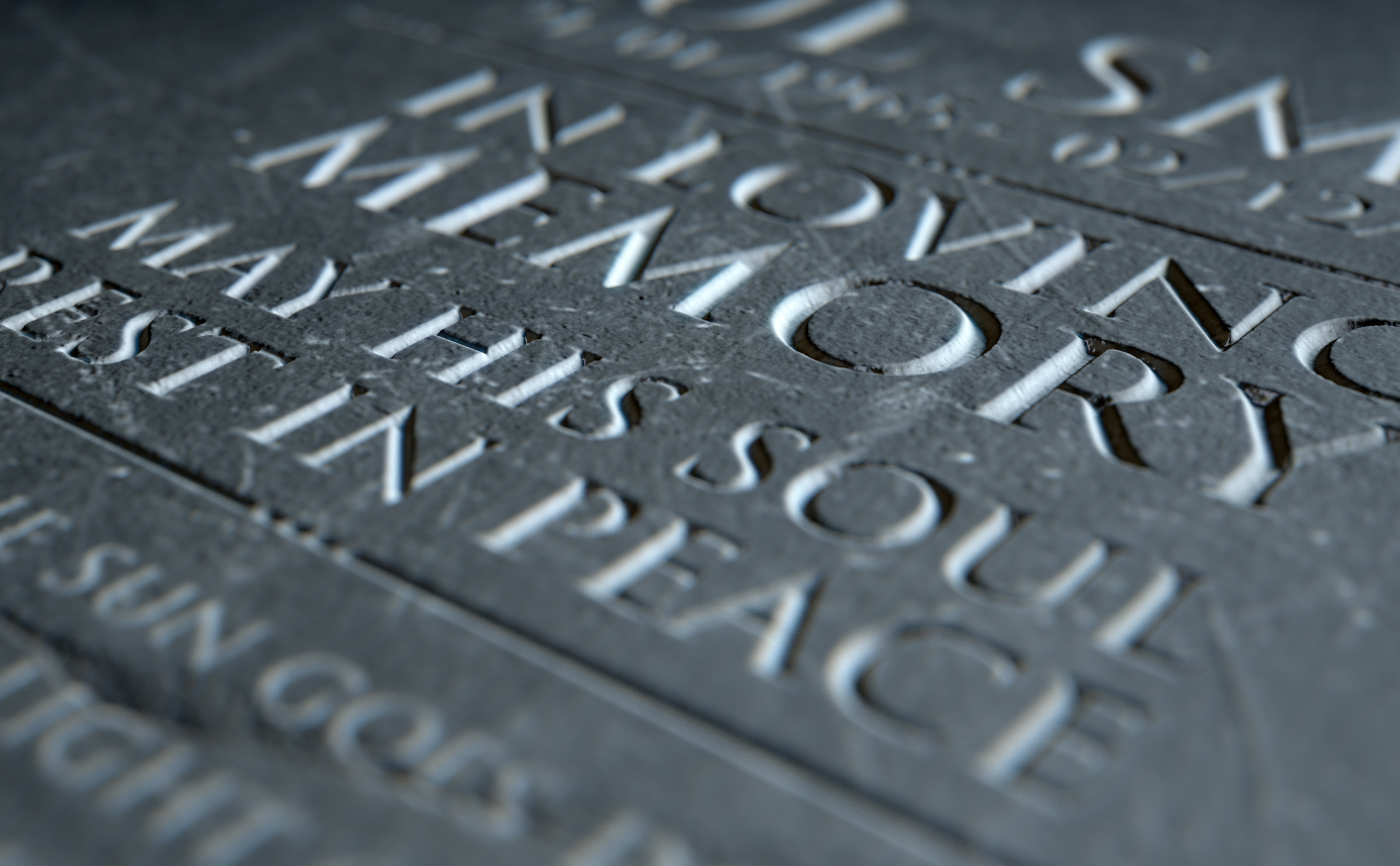
The computer-guided process can control letter size, spacing, depth and alignment. This is especially useful for longer inscriptions or memorials containing several names.
Traditional Roman lettering
Roman-style letters are widely used on memorials because they are formal, balanced and easy to read.
Their straight strokes and controlled curves reproduce well with CNC cutting. V-cutting can create angled surfaces that catch light and add depth.
This style suits both traditional and contemporary headstones.
Serif lettering
Serif typefaces include small finishing strokes at the ends of letters. These can give inscriptions a classical appearance.
CNC machinery can produce consistent serifs, provided they are not too small for the selected stone and letter size.
Script lettering
Script can create a softer and more personal appearance. It may suit short phrases, names or closing messages.
However, highly elaborate scripts can become difficult to read, particularly when engraved at a small size. The connections between letters should be clear, and overly thin strokes should be avoided.
Contemporary sans-serif lettering
Simple sans-serif typefaces can work well on modern memorials. Their clean lines complement polished granite, geometric headstones and restrained ornamentation.
They can also improve legibility where the available inscription space is limited.
The chosen typeface should reflect the overall design. Mixing too many lettering styles can make the memorial look inconsistent.
Do floral designs work well with CNC engraving?
Floral motifs can work very effectively with CNC engraving, especially when the design uses clear outlines and distinct shapes.
Roses, lilies, poppies, daffodils and leaves are common choices. They can be used as individual ornaments, corner details or borders around an inscription.
A line-based floral design can be cut into the surface and highlighted for contrast. More complex relief effects may also be possible, depending on the machine, stone and depth of cut.
The strongest floral designs usually avoid excessive detail. A rose containing too many tiny petals may look impressive on a large digital screen but become unclear when reduced to a small panel.
The design should be simplified so the main features remain visible from a normal viewing distance.
CNC engraving can also create matching flowers on both sides of a memorial. This symmetry can be difficult and time-consuming to reproduce by hand.
However, families do not have to choose perfectly mirrored ornament. A single asymmetrical stem or natural arrangement may feel more personal and less formal.
Which religious symbols suit CNC engraving?
Many religious and spiritual symbols can be reproduced accurately using CNC techniques.
Crosses are particularly suitable because their shape can be cut with clean edges and consistent proportions. The cross may be simple, Celtic, Latin, Orthodox or incorporated into a larger decorative panel.
Other suitable symbols may include:
- Doves
- Praying hands
- Angels
- Sacred hearts
- Stars
- Crescents
- Menorahs
- Om symbols
- Dharma wheels
- Lotus flowers
The design should be respectful and appropriate to the individual’s faith. Families should also check whether the burial ground permits the chosen symbol.
Multi-faith cemeteries may accept a broad range of emblems, while churchyards can have stricter rules.
CNC engraving allows a recognised symbol to be reproduced consistently, but it should still be adapted to the memorial rather than inserted without considering its scale and placement.
Can hobbies and personal interests be CNC engraved?
Yes. Personal symbols connected with hobbies, occupations and interests are often well suited to CNC engraving.
A family might request:
- A musical instrument
- A fishing scene
- Gardening tools
- A football-related emblem
- A sailing boat
- A vehicle outline
- A sewing motif
- A military badge
- A professional symbol
- A pet silhouette
The best designs are usually based on clear, recognisable outlines.
A simple guitar shape may engrave more effectively than a detailed photograph of someone performing on stage. A line drawing of a boat may remain clearer than a complex coastal scene with many small features.
Official logos, club badges and protected emblems may also involve permission or usage restrictions. Families should confirm whether they are entitled to reproduce the design.
The mason can often convert a photograph or rough sketch into a simplified line image suitable for cutting.
Are landscapes suitable for CNC engraving?
Landscapes can be used, but they need careful interpretation.
CNC machinery works best with defined lines, shapes and depth levels. A detailed photograph containing clouds, foliage, water reflections and subtle shading may not translate directly into cut stone.
The image may need to be simplified into its main features, such as:
- A recognisable skyline
- A mountain outline
- A tree silhouette
- A church or building
- A shoreline
- A path or horizon
- A small number of foreground details
This can create a strong, symbolic representation without attempting to reproduce every visual element.
For highly realistic landscapes with tonal shading, laser etching on polished dark granite may be more appropriate. Laser technology can reproduce subtle variations more effectively than conventional CNC cutting.
The family should decide whether they want a sculptural line design or a more photographic image.
Do geometric borders and patterns work well?
Geometric ornament is especially well suited to computer-controlled engraving.
The machine can repeat shapes evenly and maintain consistent spacing around the edge of a memorial. This is useful for Greek key patterns, interlocking lines, decorative corners and symmetrical borders.
Celtic knotwork can also work well because it depends on precise interwoven lines. The design must still be scaled carefully so the crossing points remain clear.
Islamic geometric patterns, simple latticework and repeated cultural motifs may also be suitable, provided they are used respectfully.
Borders should frame the inscription rather than reduce the available space excessively. A wide or highly detailed border can make the centre of the memorial feel crowded.
The thickness of the lines should be appropriate for the stone and long-term weathering.
Can CNC engraving reproduce photographs?
Standard CNC engraving is not normally the best method for reproducing a detailed photographic portrait.
A photograph contains tonal changes, soft shadows and subtle facial features. CNC cutting is better suited to defined shapes, outlines and controlled depths.
A photograph can sometimes be converted into a simplified line portrait, but this creates an interpretation rather than a realistic copy.
For a detailed portrait, families may prefer:
- Laser etching on dark polished granite
- Hand etching
- A ceramic photo plaque
- A porcelain image
- Enamelled memorial artwork
CNC engraving can still be used around the portrait for lettering, borders and ornamentation.
Combining techniques often produces a better result than expecting one process to handle every element.
What memorial shapes complement CNC engraving?
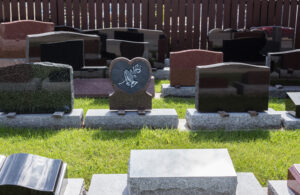
CNC engraving can be used on many headstone shapes, but flat and evenly finished surfaces generally provide the greatest design freedom.
Traditional upright headstones
A broad upright face can accommodate inscriptions, borders and central ornament.
Rounded, ogee and shouldered tops can all work well, provided the layout follows the stone’s shape.
Heart-shaped memorials
CNC engraving can create balanced lettering and decorative details within the curved surface of a heart memorial.
Flowers, doves and intertwined rings may complement the form.
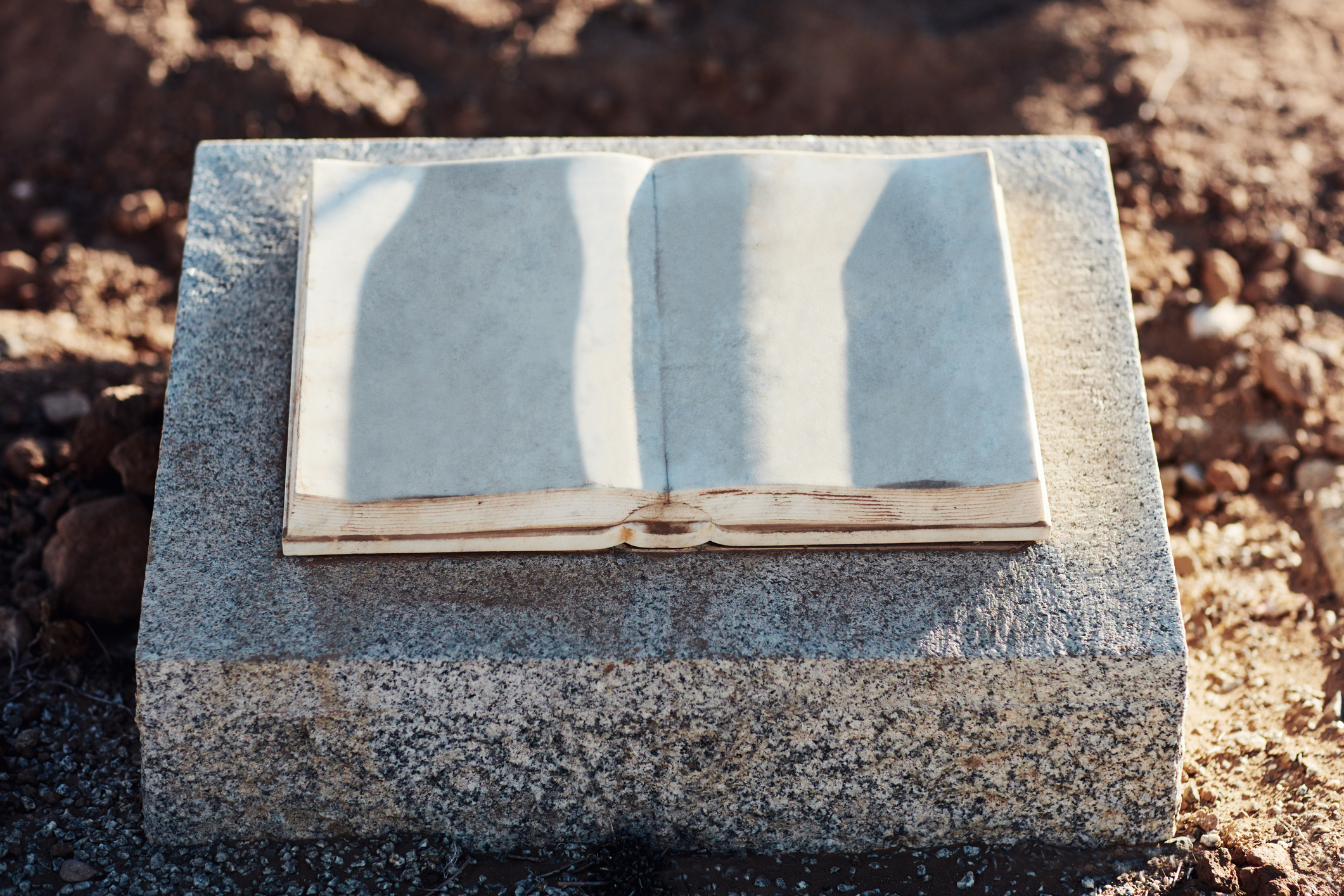
Memorial books
Open-book designs often use CNC engraving for names, dates and verses. The machine can position wording accurately across the curved or sloping pages.
Each page may carry a separate inscription, symbol or decorative feature.
Kerb set headstones
A larger headstone used with a kerb set can provide space for more extensive CNC ornamentation.
Matching patterns may also be engraved on the base or foot section, although the design should remain restrained enough to avoid visual clutter.
Cremation memorials
Compact tablets and mini memorials can benefit from precise CNC lettering because space is limited.
Simple, clearly scaled symbols are usually more successful than highly detailed artwork on smaller stones.
How does CNC engraving compare with hand carving?
CNC engraving and hand carving create different qualities.
CNC machinery excels at precision, repetition and consistency. It can reproduce approved digital artwork accurately and maintain even depths across lettering and patterns.
Hand carving introduces the interpretation of the craftsperson. The carver can adjust the work continually in response to the stone, creating subtle variations, texture and sculptural depth.
A hand carved flower may have individual petals shaped in relief. A CNC version may have cleaner, more consistent outlines.
The choice depends on the desired result.
CNC engraving may be preferable when:
- The design requires symmetry
- Lettering must be highly consistent
- Digital artwork needs accurate reproduction
- Several matching motifs are required
- Clean geometric patterns are important
Hand carving may be preferable when:
- A softer, traditional appearance is wanted
- The design needs deep sculptural relief
- Natural variation is part of the appeal
- The stone has an irregular or rustic surface
- The family wants visible hand craftsmanship
The two methods can also be combined. CNC equipment may create the initial shape before a craftsperson adds hand-finished details.
How deep should CNC engraving be?
The correct depth depends on the stone, design and intended finish.
Lettering needs enough depth to remain visible and hold any chosen paint or gilding. Decorative lines should be strong enough to survive weathering without appearing excessively heavy.
Very shallow engraving can lose definition as the memorial ages. This is particularly relevant for marble, limestone and sandstone, which may weather more visibly than polished granite.
Cutting too deeply can also cause problems. Fine areas may become fragile, and overly deep designs can collect dirt and water.
The mason should determine a suitable depth based on:
- Stone hardness
- Grain size
- Letter dimensions
- Line thickness
- Outdoor exposure
- Whether colour infill will be used
- The visual effect required
There is no single depth that suits every design.
Can engraved details be coloured?
Yes. Cut lettering and designs can often be highlighted with suitable paint, enamel or gold leaf.
Colour can improve contrast and make an inscription easier to read. Gold lettering is commonly used on polished black granite, while white, silver or other restrained colours may suit different stones.
Floral details can also include selective colour, although families should consider how the design will look if the colour eventually fades.
Any infill applied outdoors will require maintenance over time. Exposure to sunlight, rain, frost and cleaning can gradually reduce its intensity.
The engraved design should ideally remain understandable even if the highlighting becomes worn.
Too many colours can make a memorial look busy. A limited palette usually creates a more dignified and coherent appearance.
What details are too fine for CNC engraving?
Fine detail is not always beneficial.
Very thin lines, tiny lettering and complicated patterns may be difficult to cut cleanly or may weather quickly. The grain of the stone can also interrupt small features.
Common problems include:
- Facial details reduced to a very small size
- Dense foliage with many narrow branches
- Long passages in tiny lettering
- Logos containing extremely fine text
- Closely spaced knotwork
- Delicate shading intended to look photographic
- Narrow projecting shapes that may chip
Artwork should be assessed at the actual size it will appear on the memorial. A design that looks clear on a large monitor may become unreadable when reduced.
Simplifying the image often improves both appearance and longevity.
What should families check before approving the design?
A digital proof should be reviewed carefully before the stone is engraved.
Families should check:
- All names are spelt correctly.
- Dates are accurate.
- Punctuation is consistent.
- Family relationships are described correctly.
- The wording has been approved by everyone concerned.
- The image is facing the intended direction.
- The ornament is proportionate to the stone.
- Lettering remains easy to read.
- Future inscription space has been considered.
- Cemetery approval has been obtained.
It can help to print the design at full scale. This gives a more realistic impression of letter size and spacing than viewing it on a screen.
Several family members should review the proof independently. Familiar wording can be surprisingly easy to misread when it has been seen repeatedly.
Once engraving begins, corrections may require filling, resurfacing or replacing part of the stone.
Are CNC-engraved memorials accepted in all burial grounds?
The production method itself may not be the main concern. Burial authorities are usually more interested in the finished appearance, dimensions, material, finish and inscription.
A cemetery may allow CNC engraving but restrict particular images, colours or decorative styles.
Churchyards often favour restrained memorials that suit the character of the setting. Highly polished finishes, large photographic scenes or elaborate ornament may require special approval or may not be accepted.
Families should obtain written permission before production begins.
The application may need to include the full inscription and a drawing showing all engraved details. Changing the ornament after approval could require a revised application.
An experienced monumental mason can help interpret the regulations and prepare the required documentation.
How can families avoid an overcrowded memorial?
CNC technology can produce complex designs, but the ability to add detail does not mean every available space should be filled.
A memorial needs areas of plain stone to give the inscription and ornament room to breathe.
Families often want to include many meaningful details, such as photographs, flowers, symbols, verses, hobbies and decorative borders. Including all of them can weaken the impact of each individual element.
A clearer approach is to choose one main focal point and one or two supporting details.
For example, a memorial might include:
- A central floral motif with a simple border
- A portrait with restrained lettering
- A religious symbol above the inscription
- One personal emblem placed beneath the name
The design should still be easy to understand from several steps away.
Frequently Asked Questions
Can any digital image be used for CNC engraving?
Not every digital image is suitable without modification. Clear line drawings and bold shapes work best. Photographs and detailed artwork usually need to be simplified before they can be cut effectively into stone.
Is CNC engraving only suitable for granite?
No. CNC engraving can be used on granite, marble, limestone and some sandstones. The design and cutting depth must be adapted to the hardness, grain and weathering characteristics of the chosen stone.
Can CNC engraving create raised lettering?
CNC machinery can remove the surrounding stone to leave letters or ornament standing in relief. This is more complex than cutting recessed lettering and depends on the material, design and available depth.
Does CNC engraving last outdoors?
Well-designed CNC engraving can remain visible for many years. Longevity depends on the stone, depth, line thickness, exposure and maintenance. Highlighting paint or gold leaf may need renewal before the engraving itself does.
Can a CNC design be changed after engraving?
Minor adjustments may sometimes be possible, but significant changes can be difficult. Correcting mistakes may require resurfacing or replacing the affected stone, so the proof should be checked thoroughly before production.
Choosing a CNC design that remains clear and meaningful
The memorial designs that work best with CNC engraving are those that combine precision with visual clarity.
Lettering, floral ornament, religious symbols, geometric borders and simplified personal images can all be reproduced effectively. Granite is particularly well suited to crisp, detailed work, while marble, limestone and sandstone usually require designs adapted to their grain and weathering characteristics.
The strongest results are not necessarily the most complicated. Bold outlines, balanced spacing and carefully selected details tend to remain more readable and dignified over time.
Families should begin with the meaning they want the memorial to convey. The design can then be adapted to the stone and production method rather than allowing the technology to dictate the tribute.
By working with an experienced memorial mason, reviewing a full-scale proof and confirming burial ground approval, families can create a CNC-engraved memorial that is precise, personal and appropriate for long-term remembrance.
For guidance on CNC engraving, personalised memorial ornament and suitable natural stone, contact Somerville Stone on 02392 824457, email info@somervillestone.co.uk, or visit Somerville Stone. The team can help turn meaningful ideas into a balanced memorial design suited to the chosen stone and burial ground.