
Before choosing a memorial for a loved one, it is important to understand the cemetery headstone regulations that may affect its design, size, material and installation. These requirements help protect the safety, appearance and long-term maintenance of burial grounds, but they are not necessarily the same at every cemetery.
Families are sometimes surprised to discover that a headstone they have chosen cannot be installed in their preferred burial ground. Certain designs, materials, finishes and decorative features may be restricted, while formal permission is generally required before memorial work can begin.
Understanding these requirements early can help avoid unnecessary expense, delays and disappointment.
Who Sets the Regulations for Cemetery Headstones?
There is no single set of design regulations that applies identically to every cemetery throughout the UK.
Individual burial authorities establish requirements for the memorials permitted within the grounds they manage. These may include local councils, private cemetery operators and religious authorities.
The rules depend on several factors, including the type of burial ground, its layout and the organisation responsible for its management.
Local authority cemeteries
Many cemeteries in England are managed by local councils, which establish regulations covering memorial design, installation and maintenance.
Requirements can differ between neighbouring councils and even between individual sections of the same cemetery.
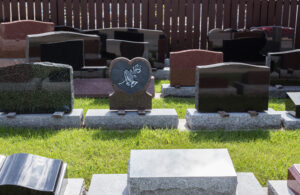
For example, a lawn cemetery section may permit upright headstones on standard bases but prohibit full kerb surrounds. Another section may allow more traditional grave layouts with additional decorative features.
A family purchasing a memorial should therefore establish not only which cemetery the grave is located in, but also the rules applying to that particular grave section.
Privately managed cemeteries
Private burial grounds may establish their own memorial regulations.
Some provide considerable flexibility in the choice of materials and designs, while others maintain strict requirements intended to preserve a particular landscape or appearance.
Natural burial grounds can have especially different approaches. Certain sites restrict permanent stone memorials or favour biodegradable markers.
The cemetery operator should be consulted before any design is finalised.
Churchyards
Churchyards, particularly those belonging to the Church of England, operate under a separate system of permissions.
Church of England memorials are subject to diocesan churchyard regulations, which commonly specify acceptable materials, dimensions, finishes and inscriptions.
A memorial falling outside these requirements may need special permission through a process known as a faculty application.
The Church of England memorial guidance explains that permission must be obtained before introducing a memorial into a churchyard.
The Church of England
Do You Need Permission Before Installing a Headstone?
In most managed UK cemeteries, a memorial permit or equivalent approval is required before a headstone can be installed.
This approval confirms that the proposed memorial meets the burial authority’s requirements.
The application commonly includes information about the grave, the person authorising the memorial and the proposed stonework.
Details may include:
- The grave location and reference number.
- The name of the registered grave rights holder.
- The memorial’s proposed dimensions and material.
- A drawing or description of the design.
- The wording and layout of the inscription.
- Details of the monumental mason responsible for installation.
Some burial authorities require applications to be submitted by a registered monumental mason rather than directly by the family.
For example, Liverpool City Council requires the holder of the exclusive right of burial to authorise a registered memorial mason to apply for installation or alterations.
Liverpool City Council
Who can authorise a memorial?
The person arranging and paying for a headstone is not necessarily the person legally entitled to authorise its installation.
In many council cemeteries, permission must come from the registered holder of the exclusive right of burial.
This is particularly important when several family members are involved in arranging a memorial or when an existing family grave is being used.
If the registered rights holder has died, the cemetery may require the burial rights to be formally transferred before approving further memorial work.
Families should establish who holds the relevant rights before placing an order.
What Restrictions Apply to Headstone Sizes and Designs?
Cemetery regulations frequently specify the maximum or permitted dimensions of memorials.
These restrictions are intended to maintain suitable spacing, prevent overcrowding and allow safe access for visitors and grounds maintenance.
Height and width restrictions
A burial authority may establish maximum heights, widths and thicknesses for upright headstones.
However, it would be misleading to suggest that all UK cemeteries share one standard maximum size.
The permitted dimensions can depend on the cemetery, grave classification and memorial type.
For example, a lawn memorial may need to fit within a specified headstone and base arrangement, while a traditional grave section may allow a larger memorial.
Choosing a design before checking these measurements creates a risk that the finished memorial will not be accepted.
Headstone shapes
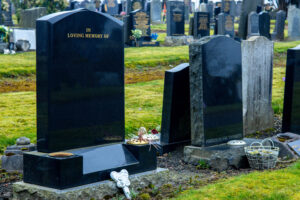
Traditional upright memorials are commonly permitted, although restrictions may apply to more elaborate designs.
Heart-shaped headstones, sculptured memorials, book designs and unusual outlines may require individual consideration.
A design being available from a monumental mason does not automatically mean it can be installed in every cemetery.
Somerville Stone offers several memorial styles, including traditional cemetery headstones, heart memorials, memorial books and hand-carved designs. The appropriate choice should account for both personal preferences and the relevant burial ground restrictions.
Kerb sets and grave surrounds
Memorial kerb sets consist of stone surrounds that define the edges of a grave.
They can create a traditional appearance and may accommodate decorative chippings or other features, subject to cemetery rules.
However, full kerb surrounds are often restricted in lawn cemetery sections because they can interfere with grass cutting and general maintenance.
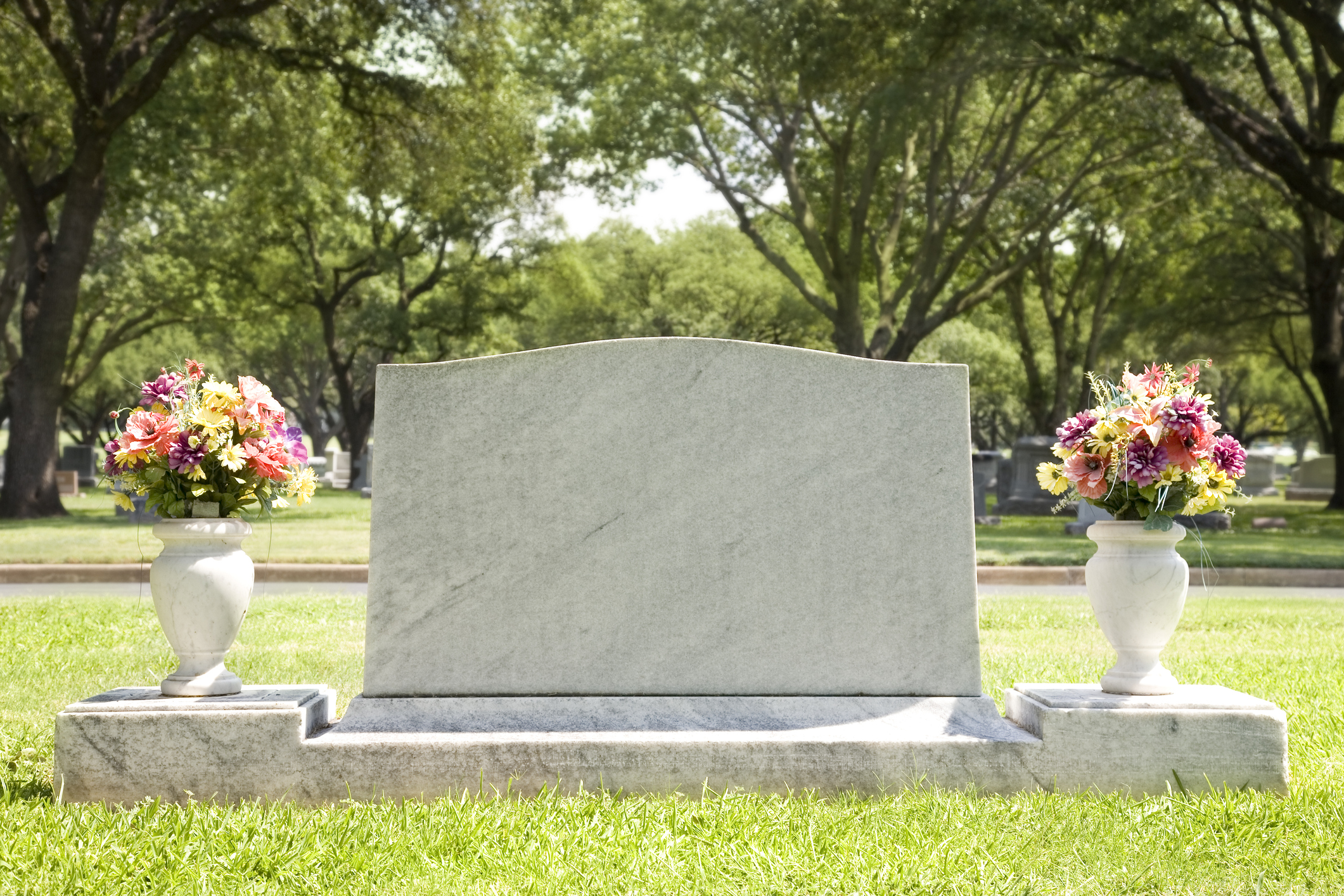
Where a full kerb set is not permitted, a smaller memorial or a permitted flower vase arrangement may be an alternative.
Are There Restrictions on Headstone Materials and Colours?
The material used for a headstone can be just as important as its size or design when obtaining approval.
Many cemeteries permit a selection of natural stones, but some impose restrictions on particular finishes or colours.
Granite is widely used for cemetery memorials because of its durability and range of available colours.
Marble, limestone, sandstone and slate are also used, although suitability varies according to the burial ground’s requirements.
Why might a cemetery reject a particular stone?
A material may be restricted because of its appearance, durability, maintenance requirements or compatibility with the surrounding memorials.
Churchyard regulations may be particularly concerned with ensuring that new memorials complement the historic character of the site.
For example, the Diocese of Southwark’s published regulations specify certain permitted natural stones and exclude highly polished reflective finishes within the ordinary approval requirements.
The Diocese of Southwark
This does not mean that polished granite is prohibited in all UK burial grounds. It illustrates why families should avoid assuming that a material accepted in one cemetery will be permitted elsewhere.
Somerville Stone works with granite, marble, slate, York stone and limestone memorials, providing families with several material options to consider once the burial ground’s requirements are established.
Do Cemetery Regulations Cover Inscriptions and Decorations?
Headstone regulations can extend beyond the physical stone to the inscription and decorative elements.
A cemetery or church authority may wish to review proposed wording, symbols and additional features before granting permission.
Religious inscriptions, quotations and personal messages are commonly used, but approval requirements can differ.
In some churchyards, inscriptions must be consistent with the religious and historical character of the setting.
Photographs, ceramic plaques, ornaments and other decorative features may also be restricted.
For families wishing to include detailed artwork or personalised imagery, it is sensible to establish what the burial authority permits before arranging engraving.
Can decorations be added later?
Additional features are not automatically exempt from cemetery regulations simply because the main headstone has already been approved.
Changes such as adding a plaque, altering an inscription or extending an existing memorial may require further permission.
This is particularly relevant where several family members will eventually be commemorated on the same headstone.
Planning for future inscriptions during the original design process can make later alterations easier.
What Safety Standards Apply to Headstone Installation?
Memorial safety is an important part of cemetery management.
Headstones are substantial stone structures, and an unstable memorial could present a danger to visitors, cemetery staff and neighbouring graves.
British Standard BS 8415 provides a code of practice for memorials within burial grounds.
Burial authorities may require memorials to be installed in accordance with this standard and may operate registration or accreditation schemes for monumental masons.
For example, Leicester City Council states that headstones in its cemeteries must meet BS 8415 and comply with requirements concerning fixing and stability.
Leicester City Council
Why professional installation matters
Proper installation involves more than positioning a headstone on the grave.
The mason must consider the memorial’s dimensions, weight, foundation arrangements and suitable fixing methods.
The exact installation requirements depend on the type of memorial and the conditions established by the burial authority.
Families should establish whether their chosen memorial supplier can arrange installation in the relevant cemetery and whether any particular installer accreditation is required.
Who is responsible for maintaining the headstone?
Responsibility for the upkeep of individual memorials generally remains with those who erected them or the appropriate rights holders.
Burial authorities also have responsibilities for managing safety within their grounds.
If a memorial becomes unstable, the cemetery authority may inspect it and take proportionate action to address an immediate risk.
The UK Government provides guidance on managing unstable gravestones in England and Wales.
GOV.UK
Families should report any obvious movement, leaning or damage to the cemetery operator and avoid attempting structural repairs themselves.
How Long Must You Wait Before Installing a Headstone?
Many families assume that a headstone can be installed immediately following a burial.
However, the appropriate waiting period depends on the burial ground’s regulations, ground conditions and the type of foundation used.
Some cemeteries recommend allowing time for the grave to settle before erecting a memorial.
Others have specific installation arrangements that make earlier fitting possible.
Leicester City Council, for example, explains that memorials may be installed relatively quickly where suitable foundations exist, while still recommending that families allow time for ground settlement.
Leicester City Council
Churchyard regulations may impose additional timing requirements. The Diocese of Southwark, for example, includes a six-month period in its ordinary memorial approval conditions.
The Diocese of Southwark
There is therefore no reliable universal waiting period that applies to every cemetery.
Before commissioning a memorial, families should ask when installation will be permitted and whether the planned timescale accounts for the necessary approvals.
What Happens if a Headstone Does Not Meet Cemetery Regulations?
A memorial that does not comply with the relevant regulations may be refused permission.
This could happen because its dimensions are unsuitable, its material is restricted or the proposed decorative elements fall outside the cemetery’s requirements.
If a memorial has already been manufactured, correcting the problem could involve additional expense.
In some circumstances, modifying the design may resolve the issue. In others, an alternative memorial may be necessary.
Installing a headstone without the required permission can also create difficulties. The burial authority may require unauthorised work to be altered or removed in accordance with its rules and applicable powers.
The simplest way to avoid these problems is to confirm the requirements before committing to manufacture.
How Can Families Check Cemetery Regulations Before Ordering?
A small amount of preparation can prevent significant difficulties later.
The following process provides a practical starting point.
- Identify the burial authority. Confirm who manages the cemetery or churchyard and obtain the relevant memorial regulations.
- Check the grave classification. Establish whether the grave is in a lawn, traditional, cremation or other section with particular restrictions.
- Confirm authorisation. Identify the registered burial rights holder and establish who must approve the memorial application.
- Review the proposed design. Check the permitted dimensions, stone, finish, inscription and decorative features.
- Discuss installation requirements. Establish whether the cemetery requires an approved mason, particular fixing standards or a waiting period.
- Obtain permission before manufacture. Where possible, ensure the chosen design has been accepted before irreversible work begins.
For families arranging memorials in Hampshire and the surrounding counties, Somerville Stone can provide guidance on choosing an appropriate headstone and understanding the relevant burial ground requirements.
Its Southsea showroom offers an opportunity to compare memorial styles and materials before making a final decision.
Frequently Asked Questions
Are cemetery headstone regulations the same throughout England?
No. Individual burial authorities can establish their own memorial requirements. Rules may differ between local council cemeteries, private burial grounds and churchyards.
Can you install a headstone yourself?
This depends on the burial authority’s requirements. Many cemeteries require installation by registered or approved monumental masons, particularly where formal safety and fixing standards apply.
Can you change an inscription after a headstone has been installed?
Yes, additional inscriptions can often be arranged. However, the registered grave rights holder may need to authorise the work, and the cemetery may require a further permit.
Are black granite headstones allowed in UK cemeteries?
Black granite is permitted in many cemeteries, but it may be restricted in certain churchyards or other burial grounds where regulations specify particular stone colours or finishes.
Can you appeal if a churchyard refuses a headstone design?
Where a proposed Church of England memorial falls outside the ordinary diocesan regulations, a faculty application may provide a route for seeking special permission. Approval is not guaranteed, and the relevant diocese can explain the procedure.
Choosing a Memorial That Meets Cemetery Requirements
Understanding cemetery headstone regulations before ordering allows families to make design decisions with greater confidence.
The most important consideration is that approval depends on the specific burial ground. A memorial that is suitable in one cemetery may require alterations or additional permission elsewhere.
By checking the relevant requirements early, families can concentrate on choosing a meaningful and lasting tribute without the added uncertainty of avoidable installation problems.
Somerville Stone provides cemetery headstones and bespoke memorials across Hampshire, Dorset, Sussex and Surrey, with guidance on materials, designs and memorial requirements.
For advice on selecting a suitable memorial, contact the team or visit the Southsea showroom.
Phone: 023 9282 4457 Email: info@somervillestone.co.uk Find out more: https://somervillestone.com