A memorial book headstone is a grave marker shaped to resemble an open or closed book. The design is often chosen because a book can represent a person’s life story, shared memories, faith or the closing of one chapter and the beginning of another.
Open-book memorials usually have two visible pages, creating space for names, dates, verses, personal messages and decorative details. Some are produced as upright headstones, while others are designed as sloping tablets, desk-style memorials or smaller markers for cremation plots.
The shape can be simple and restrained or highly detailed. A memorial book may include gently curved pages, a carved spine, folded page corners, tassels, flowers, religious symbols or other personalised ornamentation.
Although the book shape has strong traditional associations, it is not limited to one faith or style of commemoration. It can be adapted to suit religious, spiritual, secular and family memorials.
The most appropriate design will depend on the person being remembered, the burial ground regulations, the available space and the material selected.
What does a memorial book headstone look like?
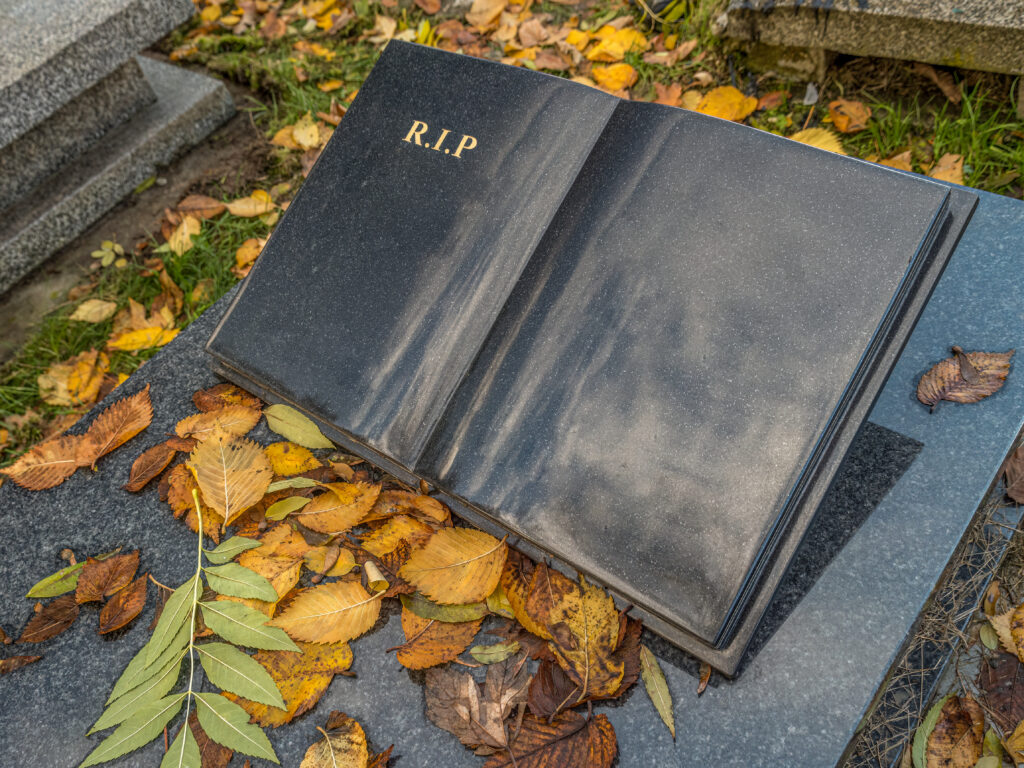
The defining feature of a memorial book headstone is its resemblance to a book. Most designs show the book open at the centre, with an inscription arranged across the two pages.
The pages may be presented vertically as part of an upright memorial or at an angle on a sloping base. Some designs place the book on a supporting rest, while others incorporate it into a larger headstone.
A simple book memorial may have clean page outlines and a small central spine. A more elaborate version might include:
- Rolled or folded page corners
- A carved bookmark or tassel
- Floral carving around the edges
- A cross, dove or other symbol
- Raised borders around each page
- A decorative base or kerb surround
Closed-book memorials are less common but can also be used. These may symbolise a completed life, a treasured story or a volume laid to rest.
The design does not have to reproduce a real book in exact detail. Some memorial books use soft, flowing curves to suggest pages without becoming overly decorative.
What does an open book memorial symbolise?
The symbolism of a memorial book can vary between families. One of its most common meanings is the story of a life.
Each life contains experiences, relationships and memories, and the open pages can represent the opportunity to reflect on those moments. The inscription becomes part of that story, recording the person’s name and the words their family has chosen to preserve.
An open book can also suggest that memories remain accessible. Although someone has died, their influence and story continue through the people who knew them.
For religious families, a book may represent scripture, faith or the Book of Life. A Bible verse, prayer or spiritual message can be placed across the pages.
For a couple or family memorial, the two-page format can represent a shared life. One page may be used for each person, creating a balanced and connected design.
The book shape may also be especially meaningful for someone who loved reading, teaching, writing, study or storytelling. In these cases, the symbolism has a direct connection with the person’s interests or profession.
How can the two pages be used?
The open format provides several ways to arrange an inscription.
For a single-person memorial, one page may contain the name and dates, while the other carries a verse, message or decorative carving. Alternatively, the inscription can flow naturally across both pages.
For a joint memorial, each page can be dedicated to one person. This is often chosen for husbands and wives, partners, siblings or other close family members.
A two-page layout might include:
- The first person’s inscription on the left and the second on the right
- Both names on one page and a shared verse on the other
- A dedication on one page and a personal symbol on the other
- A photograph or engraved image alongside the wording
- Separate religious or personal messages for each individual
The amount of text should be considered carefully. Although the shape provides two distinct areas, overcrowding the pages can make the inscription difficult to read.
A memorial mason can help balance names, dates, verses and ornamentation so the finished design remains clear and dignified.
How can a memorial book headstone be personalised?
The book form offers many opportunities for personalisation. Families can adapt the wording, lettering, material, shape and decorative elements to reflect the individual.
Personal inscriptions
The inscription is often the most important part of the memorial. It may include a formal dedication, affectionate family name, short verse, religious passage or words associated with the person’s character.
The most effective wording is not always the longest. A short, carefully chosen message can carry more meaning than a crowded inscription.
Families should consider how the words will sound when read aloud and whether they will remain meaningful in years to come.
Carved ornamentation
Flowers, leaves, crosses, birds, hearts and other symbols can be carved into the pages or around the book.
A specific flower may have personal significance, while a religious symbol can express faith. Natural imagery may suit someone who loved gardening, wildlife or the countryside.
The ornament should support the inscription rather than overpower it.
Photographs and portraits
A photo plaque or etched portrait can sometimes be added to a memorial book. This may be positioned on one page, leaving the other for the inscription.
The suitability of photographic work depends on the chosen stone and the burial ground regulations. Dark polished granite often provides a strong surface for detailed etching, while ceramic or porcelain plaques can be attached to other materials.
Lettering styles
The lettering can significantly influence the character of the memorial. Traditional Roman letters create a formal appearance, while carefully chosen script can feel softer and more personal.
Decorative lettering should remain easy to read. Very elaborate typefaces may not work well for long inscriptions or small memorials.
Lettering can be left natural or highlighted with paint, enamel or gold leaf, depending on the stone and finish.
Page details
Small carved details can make the book form more distinctive. Folded corners, a bookmark or a gently raised spine can add depth without changing the overall simplicity.
These features may be hand carved or produced using modern machinery, depending on the design and material.
Which materials are suitable for memorial book headstones?
Memorial books can be made from several types of natural stone. Each material creates a different appearance and has its own maintenance requirements.
Granite
Granite is a popular choice because it is hard, durable and available in a wide range of colours. Black, grey, blue, red and other granite varieties can all be shaped into book memorials.
Polished granite provides a formal, refined appearance and can support clear lettering, etched images and detailed ornamentation.
Because granite is dense and resistant to weathering, it is often chosen by families who want a relatively low-maintenance memorial.
Marble
Marble gives a memorial book a soft, classical appearance. Its pale colour and natural veining can complement the flowing shape of open pages.
It can also be suitable for traditional carving and curved details. However, marble generally weathers more visibly than granite and may require more careful maintenance.
Families choosing marble should understand how its surface may change over time.
Limestone
Limestone can create a traditional, understated memorial, particularly in churchyard settings. Its warm, natural colour may blend well with older surroundings.
It is suitable for hand-cut lettering and carving, although the exact finish will depend on the stone’s texture and quality.
As a porous material, limestone will weather naturally and may develop surface growth in damp or shaded locations.
Sandstone
Sandstone can suit rustic and informal book designs. Its natural colour variations and textured finish give it warmth and character.
The grain of the stone can affect the level of fine detail that can be achieved, so the design should be adapted accordingly.
The chosen material must also comply with cemetery or churchyard regulations. Some burial grounds restrict polished finishes, colours or stone types.
Are memorial book designs suitable for cremation plots?
Yes. Smaller book-shaped memorials are often used for cremation plots, gardens of remembrance and family memorial areas.
These may take the form of:
- Small sloping book tablets
- Open-book plaques on low bases
- Desk-style markers
- Book designs incorporated into mini kerbs
- Compact memorials for two sets of ashes
A cremation book memorial can provide enough space for a name, dates and short dedication while remaining within the dimensions permitted by the burial ground.
For couples or family members, the two-page layout can be particularly practical. One page may be inscribed initially, with the second reserved for a future inscription.
However, families should not assume that an empty page can always be added to later without planning. The spacing, lettering style and layout should be considered from the start to ensure both inscriptions will fit comfortably.
Can a memorial book be used for more than one person?
Book memorials are well suited to joint commemoration.
The two-page structure naturally creates separate but connected areas. This can represent two lives remembered together while allowing each person to have an individual inscription.
A joint memorial may be ordered after both people have died, or it may be designed in advance with space reserved for a second inscription.
When planning for future lettering, the mason should consider:
- The likely length of both inscriptions
- Consistent letter size and style
- Space for names, dates and relationships
- Whether a shared verse will be included
- How the stone will be removed or worked on later
Leaving an area blank without a clear plan can create an uneven layout. A balanced design should look complete after the first inscription while still accommodating the second.
Book memorials can also commemorate parents, siblings, children or wider family relationships. The symbolism is not limited to married couples.
What types of wording suit a memorial book?
The book shape works with many types of inscription, but the wording should be chosen with the available space in mind.
A typical inscription may include the person’s full name, dates of birth and death, family relationship and a short closing message.
Families might choose wording that reflects:
- Love and family connection
- Faith or spiritual belief
- Gratitude for a shared life
- A favourite saying or verse
- A person’s character or values
- The idea of a life story or final chapter
Phrases connected with books can be meaningful, but they should not feel forced. References to chapters, stories or pages work best when they genuinely reflect the person or the family’s feelings.
The burial authority may need to approve the inscription, particularly in a churchyard. Some authorities restrict wording, symbols or informal language.
It is sensible to check spelling, punctuation and dates several times before approving the final layout.
What should families consider before ordering?
A memorial book should be selected with both appearance and practical requirements in mind.
Burial ground regulations
Cemeteries and churchyards may control the permitted size, material, finish, colour and ornamentation.
Some locations accept upright book headstones but restrict desk-style tablets. Others may permit only specific dimensions for cremation memorials.
Approval should be confirmed before manufacturing begins.
Available inscription space
Curved pages and decorative borders can reduce the usable area. A design that looks spacious in a catalogue may hold less wording than expected.
The mason should provide a scaled layout showing how the inscription will appear.
Cleaning and maintenance
Recesses around the spine, page edges and carved details can collect dirt or organic growth. The amount of maintenance will depend on the stone and location.
Families should use suitable cleaning methods and avoid harsh chemicals.
Future inscriptions
Where a memorial is intended for more than one person, space should be planned carefully. The design should allow future work without compromising the balance of the first inscription.
Overall scale
A book memorial can be subtle or imposing. The size should suit the grave, surrounding memorials and the person being commemorated.
A larger design is not automatically more meaningful. Proportion, wording and craftsmanship often have a greater effect than scale alone.
How is a memorial book made?
The manufacturing process depends on the material and level of detail.
The stone is first selected and cut to the required dimensions. The book shape is then formed, including the central spine and page curves.
Modern machinery may be used to create the main profile with accuracy. Hand finishing can refine the page edges, add texture and produce decorative details.
The inscription is laid out before being cut, blasted or engraved into the surface. Carved ornament, photo plaques and highlighted lettering are then added as required.
The completed memorial must be installed using an approved foundation and fixing system. Proper installation is essential for safety and long-term stability.
The work should be completed by an experienced memorial mason who understands both stone fabrication and current installation standards.
How does a book memorial compare with a standard headstone?
A standard upright headstone provides a single broad face for lettering and ornamentation. It can suit long inscriptions and many decorative styles.
A memorial book creates a more symbolic and structured layout. The division between the pages can help separate two inscriptions or distinguish the main dedication from a verse.
The book design may feel more personal for someone associated with reading, learning or faith. It can also provide a softer alternative to a conventional rectangular headstone.
However, the curved pages may offer less usable lettering space than a similarly sized flat memorial. Cleaning can also require attention around the spine and recessed details.
Neither format is inherently better. The choice depends on the intended meaning, wording, setting and family preference.
Frequently Asked Questions
Can a memorial book be made in any colour?
The available colours depend on the chosen stone. Granite offers the widest range, while marble, limestone and sandstone generally provide softer natural tones. The burial ground may restrict certain colours or polished finishes.
Can lettering be added to a memorial book later?
Yes, provided suitable space has been reserved and the stone remains in good condition. Future lettering should be planned when the original memorial is designed to maintain a balanced layout.
Are book headstones only for religious memorials?
No. Although books can represent scripture or faith, they can also symbolise a life story, learning, memory or a shared relationship. The design can be entirely secular.
Can a photo plaque be fitted to an open-book memorial?
In many cases, yes. A plaque may be positioned on one page or integrated into the overall design. Cemetery approval and sufficient space will be required.
Is an open-book memorial difficult to clean?
It may require slightly more attention than a completely flat headstone because dirt can gather around the spine and page details. Cleaning needs will depend mainly on the material, finish and location.
Choosing a memorial that tells a personal story
A memorial book headstone is a symbolic and adaptable design that can commemorate one person, a couple or several members of a family.
Its open pages provide a natural way to arrange names, dates, verses and personal ornamentation. The shape can represent a life story, faith, shared memories or a love of reading and learning.
The design can be produced in granite, marble, limestone or sandstone and adapted for full graves or cremation plots. It can remain simple or include carved flowers, photographs, folded corners and other individual details.
Before ordering, families should consider burial ground regulations, available inscription space, future lettering and the maintenance needs of the chosen stone.
A carefully planned memorial book can provide more than a distinctive shape. It can create a lasting and meaningful record of a person’s story.
For advice on memorial book headstones, suitable materials and personalised inscriptions, contact Somerville Stone on 02392 824457, email info@somervillestone.co.uk, or visit Somerville Stone. The team can help you explore respectful memorial designs suited to your family’s wishes and the requirements of the burial ground.